Let me say this straight: I’d call myself an “agnostic atheist”. Agnostic in that “I do not know” and atheist in that “I do not believe”. In some sense, I’m all Spock – if it cannot be measured by something in a lab, it does not exist. Even love is just norepinephrine and a few other hormones. Lust is norepinephrine and a few other hormones activated through tequila. You’ll battle to convince me there is something else out there, and astrology and crystals and God – however you may define him/her/them/it – it’s all just autosuggestion and feel-good based on fear and-or-guilt, all served with a healthy dollop of culturally appropriate morality.
But am I 100% sure? As in sure sure? Well, no. 99.98% sure, because there’s something that really bothers me, and that is David Chalmers’ ‘hard question of consciousness’. It is a question which keeps me up at night, but it opened the door just a crack for something else to enter.
Enter Robert Rodriguez and his interview on Joe Rogan. Blew my mind. I love it! How Rodriguez described his creative method was inspiring, and I sent it to a buddy who is even more Spock-brained than me (in fact, I need to credit her with even using the word “Spock brain”). Her reaction hardly a minute into the show? “It’s woo”.
Huh, what? Her contention is that Rodrigues mentioned the Muse as a supernatural deity. I’m not sure I got that from the interview, but thus began a two-hour explorative journey into creativity and the origins thereof. This is why we are buddies, see. And on this topic, she tied me up in all kinds of logical knots I cannot untangle. No matter how hard Spock brain tries, I cannot get to the bottom of my own creativity without stumbling across woo-words. Like “universe” and “alchemy with better grammar”.
Here’s the thing – and I wrote about it before – I do not know where my stories come from. The Felicity Street series literally just dropped into my lap one random morning. I was not thinking about writing a new book – let alone a series. It just… it just came! And here’s where I start skating on shaky ground: I am 100% convinced I do not tell the stories. And here, I want to cite something allegedly said by Sir Paul McCartney: I do not write the songs, the songs choose me to get written by. This is how I feel about all my novels, published and unpublished. I create the character, set the scene, and then take dictation. Truman Capote once insulted Jack Kerouac by saying, “That’s not writing, that’s typing”, and honestly, sometimes that’s how I feel in my novels: I’m just part of the cosmic typing pool taking dictation form something which scares the shit out of me.
 Where do these stories come from? Hey, if Rodriguez wants to call it the Muse, I’m not going to contradict him. In fact, He’d be in good company. The first person I’ll cite here is Steven Pressfield, and his amazing work The War of Art. There, Pressfield directly cites the invocation of the Muse from Homer’s Odyssey. Do I believe that Pressfield has a metaphysical belief in the Muse the way buddy Ulrike would believes Jesus Christ the Saviour? No, I do not. What I do believe is this is Pressfield’s way of admitting he has no idea where creativity comes from. My favourite human, Nick Cave, once cited his ‘fragile relationship with the Muse’, but admits to not liking the concept. If I recall correctly, even Stephen King mentioned something similar in On Writing, but do not quote me on that one. But King stated quite categorically no matter how many times he tried to rewrite the last act of Cujo, the kid still died.
If I’m intellectually honest, writing is like ponytails, relationships, and farts: if you have to force it, it’s probably shit. The worst writing I did in my life was where I tried to ignore the ‘flow’ of the story, ignore the download, stop taking dictation, and ‘force’ the story my way. I have unpublishable drivel on my hard drive thanks to me forcing an issue. But the good stuff, like Defining Giulia? I just sat back and let Jesus take the keyboard.
 Jesus? The Muse? A portal in the universe? The collective subconscious? I really have no idea. But I know it works. And I’ve learned not to force it, and I also know to definitely, never, ever, fuck with it. I’ve published seven books now, both fiction and non-fiction, both under my own name and ghost-written for others. I have come to trust the process.
Process? Spock-brain likes that word. It is clean and scientific and can be explained through muscle memory, psychology, and hormones. But there’s more to me than my agnostic atheist Spock brain. I cannot look at the books I’ve read, the shows I’ve seen, the music I’ve heard, the paintings I admired and say it’s merely as a result something as clinical as ‘process’. Process is what detectives use to catch criminals. It’s not what artists use to inspire the world.
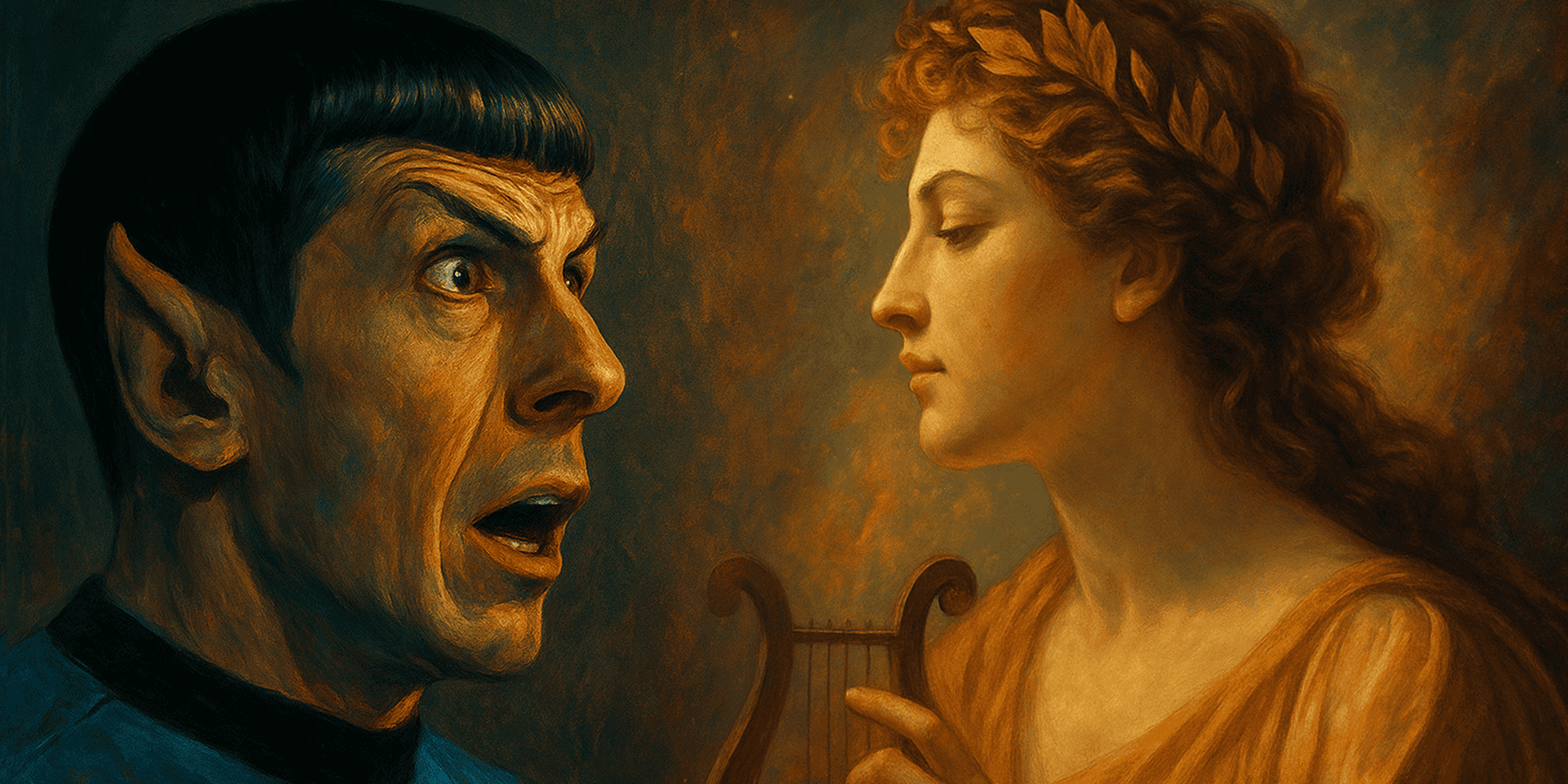
For now, if Rodriguez and Pressfield and Cave want to credit the Muse, I’ll join them. I have no idea what the Muse is – maybe she is just hormones and psychology and neurons having a rave – but I know enough to acknowledge without her, my own bookshelf will be barren. For that, I’ll have faith in the Muse, even if I have no idea what it means, because Spock met the Muse and it blew his mind!
Now, if you’ll excuse me, the Muse is knocking, its time to go appease.